Chatsworth, California
ICD-10 · CPT · HCPCS Coding

Bad Coding Isn't Just a
Compliance Risk — It's a
Daily Revenue Leak.

Incorrect diagnosis codes, undercoded E&M levels, unbundled procedures, and unsupported specificity cost providers an estimated $262 billion in lost or delayed revenue every year. Healthcare Logic's certified coders work from clinical documentation to capture every legitimate dollar — accurately, compliantly, and on time.
40% Of Practices Leave
Revenue via Undercoding
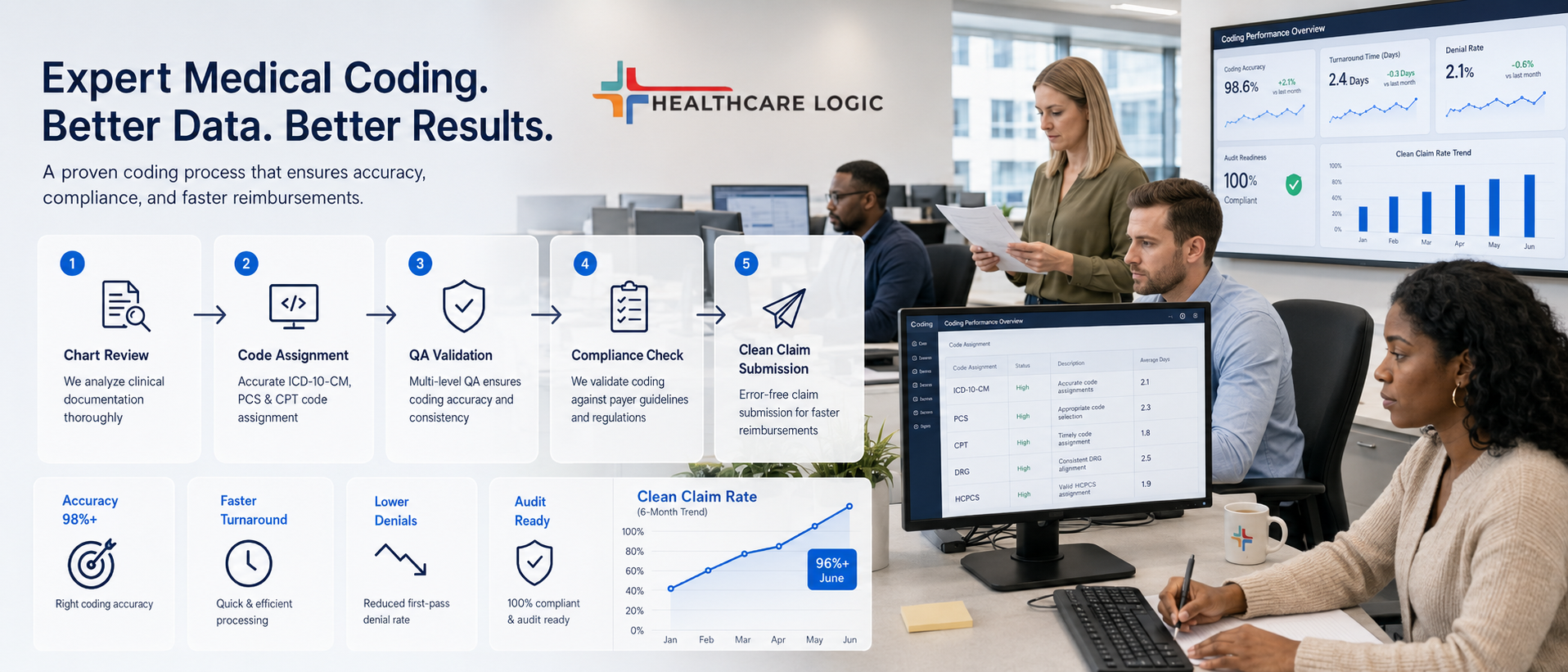
96% First-Pass Clean
Claims Rate — HL Avg
48hr Standard Coding
Turnaround Time
Dashboard

Inaccurate Medical Coding Costs Providers on Both Sides of the Ledger

Undercoding leaves legitimate revenue uncaptured. Overcoding creates compliance liability and audit exposure. Coding errors trigger denials that cost $25 each to rework. And poor documentation specificity leaves money on the table that your clinical team earned and documented — just not coded correctly.

Undercoding Is the Silent Revenue Killer in Medical Practices

Studies published in the Journal of the American Medical Association and MGMA benchmarks consistently show that 40% or more of medical practices systematically undercode evaluation and management (E&M) visits — billing lower-complexity codes than documentation supports out of habit, caution, or limited coding training. A single level of E&M undercoding across a 3-physician practice can represent $90,000–$140,000 in uncaptured annual revenue.

ICD-10 Specificity Errors Trigger Automatic Payer Denials

ICD-10-CM has over 70,000 codes — and payers use automated claim editing systems (NCCI, CCI, payer-specific edits) that reject claims when diagnosis codes lack the specificity required for the billed procedure. A coder selecting an unspecified ICD-10 code when a specific one exists — even by one digit — can result in an immediate denial that requires manual rework, delays payment by 30–60 days, and occasionally results in permanent write-off.

Annual CPT Code Updates Create Constant Compliance Risk

The AMA releases CPT updates annually — with new codes, deleted codes, revised descriptions, and changed bundling rules effective January 1 each year. In 2023 alone, over 400 CPT changes took effect, including major restructuring of E&M office visit codes. Practices relying on in-house billing staff who haven't completed annual coding education routinely bill deleted or incorrect CPT codes for months after updates take effect, accumulating denials and compliance exposure.

Provider Documentation Gaps Cannot Be Solved with Better Coding Alone

The most common root cause of coding inaccuracy is not the coder — it's the clinical note. When provider documentation is vague, incomplete, or lacks the clinical indicators needed for a specific ICD-10 code or E&M level, even the most experienced coder cannot assign the correct code without querying the provider. Without a formal Provider Query process integrated into the coding workflow, documentation gaps result in perpetual undercoding.

Coding Revenue Exposure: A Typical 5-Provider Practice
Revenue lost to systematic E&M undercoding$185K/yr
Claims denied due to ICD-10 specificity errors$72K/yr
Revenue delayed by coding-related rework$55K/yr
Unbundled CPT codes written off after denial$38K/yr
Estimated Annual Coding Revenue Gap ~$350K

* Estimates based on JAMA, MGMA, and AAPC benchmarks for a multi-provider ambulatory practice. Healthcare Logic provides a free coding audit — including E&M level distribution analysis — to quantify your actual coding gap.

Complete Medical Coding Services — ICD-10, CPT & HCPCS

Healthcare Logic provides full-spectrum medical coding for physician practices, FQHCs, hospitals, and health systems — with certified coders, documented specialty training, and a pre-submission audit layer that catches errors before they become denials.

01

ICD-10-CM Diagnosis Coding with Specificity Focus

Our coders assign ICD-10-CM diagnosis codes to the highest level of specificity supported by clinical documentation — capturing laterality, acuity, episode of care, and complication codes that payers require for payment. We do not default to unspecified codes when specific codes are available and documentable, and we query providers when documentation falls short of the required specificity.

02

Evaluation & Management (E&M) Level Optimization

E&M coding is the single highest-value coding function for most physician practices, and also the most consistently undercoded. We apply 2023 AMA E&M guidelines — using medical decision-making (MDM) or total time as the primary level determinant — and review documentation for all elements required to support the level billed, querying providers when notes are incomplete rather than defaulting to a lower level.

03

CPT Procedure Coding & Bundling Compliance

We assign CPT procedure codes for all service types — office procedures, surgical procedures, diagnostic studies, infusions, and ancillary services — with explicit attention to NCCI bundling edits, modifier application, and payer-specific coding policies. Modifier 25, 59, 51, and global period rules are applied consistently and documented for payer audit defense.

04

HCPCS Level II Coding for Supplies, Drugs & DME

HCPCS Level II codes are required for supplies, injectable and infused drugs, durable medical equipment, prosthetics, orthotics, and certain transportation services — all of which bill separately from CPT codes and carry their own payer-specific coverage and quantity rules. Our coders assign HCPCS codes with the correct units, modifiers, and NDC numbers for drug billing, preventing denials for missing or incorrect HCPCS data.

05

Prospective & Retrospective Coding Audits

We conduct both prospective audits (before submission, for high-risk specialties or payers) and retrospective audits (of coded encounters already submitted) to identify coding accuracy, specificity compliance, and revenue leakage from undercoding. Audit results include quantified revenue recovery estimates, coder-level error rate reports, and provider documentation pattern analysis — giving leadership a clear return on investment calculation.

06

Provider Query & Documentation Improvement Programs

When clinical documentation cannot support accurate coding, our coders generate AHIMA- and ACDIS-compliant provider queries — formal, non-leading requests for clarification that allow physicians to complete the clinical record without compromising documentation integrity. Over time, provider query patterns identify systemic documentation gaps, enabling targeted education that improves note quality at the source rather than patching it one encounter at a time.

How Healthcare Logic Delivers Clean, Compliant Codes

A five-stage medical coding workflow — from documentation receipt to billing-ready code output — built for accuracy, speed, and compliance at every step.

Stage 01
Documentation Receipt
Clinical notes, op reports, and diagnostic results are received via your EHR integration, secure file transfer, or direct system access — no printing, scanning, or manual handoff required.
Stage 02
Clinical Review
The assigned coder — credentialed in your specialty — reviews the full clinical documentation to identify all diagnoses, procedures, and services documented and codeable for the encounter.
Stage 03
Code Assignment
ICD-10, CPT, and HCPCS codes are assigned to maximum specificity, with correct modifiers, units, and bundling compliance — all cross-referenced against current NCCI edits and payer-specific policies.
Stage 04
Query or Audit
Documentation gaps trigger a provider query before codes are finalized. High-risk encounters go through a second-coder pre-submission audit for complex procedures, high-value E&M visits, and surgery.
Stage 05
Output & Delivery
Finalized codes are delivered into your billing system within 24–48 hours of documentation receipt — with coder notes, modifier rationale, and query resolutions documented for audit defense.
Certified Coders + Compliance Layer

Coding Accuracy You Can Take to an Audit.

Healthcare Logic's medical coding team combines active credentialing, specialty-specific training, and a documented compliance framework — so every code we assign can be defended in a payer audit, a RAC review, or an internal compliance investigation.

CPC, CCS & RHIA Credentialed Coding Staff

All Healthcare Logic coders hold active AAPC or AHIMA credentials — CPC, CCS, RHIA, or specialty-specific certifications — and complete annual continuing education aligned with AAPC and AHIMA requirements to maintain certification and stay current with code set updates.

NCCI Edit & Payer-Specific Policy Compliance

Every code set is cross-validated against CMS National Correct Coding Initiative (NCCI) edits, Medicare Local Coverage Determinations (LCDs), and major commercial payer-specific coding policies before submission — catching edit-triggering code combinations before they reach the payer.

Specialty-Specific Coding Teams by Service Line

Coders are assigned to your specialty — not rotated through a general pool. Cardiology encounters are coded by coders with documented cardiology coding experience. Behavioral health by behavioral health coders. Specificity and accuracy rates improve significantly when coders know the clinical context of the services they are coding.

Coding KPIs Tracked Monthly in Logic Analytics

Clean claims rate, coding-related denial rate, E&M level distribution, query volume and resolution rate, and coder accuracy scores are all reported monthly in your Logic Analytics dashboard — giving leadership visibility into coding performance trends and return on investment.

Coding Performance Dashboard
First-Pass Clean Claims Rate96.2%
Coding-Related Denial Rate1.4%
Avg Coding Turnaround36 hrs
Provider Query Resolution Rate93.8%
Clean Claims Rate96%
Query Resolution Rate94%
Coding Denial Rate1.4%
↓ 86%
below industry avg
coding denial rate

Coding Expertise Across Every Specialty We Serve

Each specialty has its own coding ruleset, documentation requirements, and payer-specific policies. Healthcare Logic assigns coders with documented specialty training to every client — not generalists trying to code across every service line at once.

FQHCs & Community Health Centers

FQHC Cost-Report & Visit Coding

  • FQHC prospective payment system (PPS) encounter coding
  • Preventive visit vs. medical visit determination for FQHC billing
  • Mental health and substance use disorder visit coding per HRSA rules
  • Enabling services and case management CPT code documentation
  • UDS reporting alignment and productivity denominator coding
Cardiology

Cardiac Procedure & Diagnostic Coding

  • Interventional cardiology CPT codes including catheterization and stenting
  • Echocardiography, stress testing, and Holter monitor coding
  • Cardiac device implant and remote monitoring HCPCS coding
  • ICD-10 specificity for coronary artery disease, heart failure, and arrhythmia
  • Global period and multiple procedure modifier application
Orthopedics & Pain Management

Surgical & Procedure-Heavy Coding

  • Orthopedic surgical CPT coding including joint replacement, fracture care, and arthroscopy
  • Pain management injection and fluoroscopy guidance code bundling
  • ICD-10 laterality and acuity coding for musculoskeletal diagnoses
  • Implant device and graft HCPCS coding with manufacturer passthrough rules
  • Workers' comp and auto injury coding requirements by state
Behavioral Health

Mental Health & SUD Coding Compliance

  • CPT coding for individual, group, and family psychotherapy by session length
  • ICD-10-CM specificity for DSM-5 diagnosis coding and substance use disorders
  • E&M + psychotherapy add-on code billing when applicable
  • Telehealth place-of-service and modifier coding by payer
  • Crisis service, intensive outpatient, and partial hospitalization CPT coding
Nephrology & Dialysis

ESRD Bundled & Non-Bundled Service Coding

  • ESRD monthly capitation payment (MCP) code assignment by patient status
  • Non-ESRD dialysis service and acute dialysis CPT coding
  • Vascular access procedure CPT coding including fistula and graft procedures
  • ICD-10 CKD staging and ESRD complication coding for risk adjustment
  • Separately billable drug and supply HCPCS coding outside the ESRD bundle
Ambulatory Surgery & Hospitals

Facility & Inpatient Coding

  • ICD-10-PCS inpatient procedure coding for MS-DRG optimization
  • ASC facility fee coding and payer-covered procedure verification
  • Principal diagnosis and present-on-admission (POA) indicator assignment
  • CC and MCC complication coding for DRG severity capture
  • Outpatient APC coding under OPPS for hospital outpatient departments

Frequently Asked Questions About Medical Coding Services

Healthcare Logic coders are certified in ICD-10-CM and ICD-10-PCS diagnosis and procedure coding, CPT (Current Procedural Terminology) for physician and outpatient services, HCPCS Level II for supplies, drugs, and durable medical equipment, and CDT codes for dental services. All coders hold active credentials including CPC, CCS, or RHIA and complete annual continuing education to maintain coding accuracy under annual code set updates.
The majority of coding-related denials stem from specificity errors, unsupported diagnoses, or mismatched CPT and ICD-10 code combinations. Healthcare Logic coders work from the clinical documentation — querying providers when documentation is insufficient — and apply payer-specific coding guidelines before submission. Our pre-submission coding audit layer catches unbundling, upcoding, and documentation gaps that trigger automated payer edits. Clients typically see coding-related denial rates drop below 2% within 60 days.
Yes. Healthcare Logic has specialty-trained coders for E&M across all care settings, cardiology, orthopedics, neurology, pain management, behavioral health, nephrology and dialysis, ophthalmology and retina, dermatology, chiropractic, dental, ambulatory surgery, and inpatient facility coding. Each specialty uses coders with documented experience in that specialty's CPT, ICD-10, and payer-specific coding rules.
Standard coding turnaround is 24 to 48 hours from receipt of the clinical documentation. For high-volume clients with time-sensitive billing cycles, we offer same-day coding for documentation received before 12 PM. Emergency or backlog clearance projects are scoped and staffed individually. All coding outputs are delivered in your preferred format — directly into your EHR/PM system or via structured file.
When clinical documentation does not support the specificity needed for accurate coding, our coders issue a Provider Query — a formal, compliant documentation clarification request following AHIMA and ACDIS query guidelines. Queries are targeted, non-leading, and designed to complete the clinical picture without directing the provider to a specific code. We track query response rates and resolution times as part of our monthly coding performance reporting.
Yes — coding audits are available as both a standalone service and as an ongoing component of our coding program. Retrospective audits review a statistically valid sample of coded encounters for accuracy, specificity, compliance with payer guidelines, and documentation support. Audit results identify specific coder errors, provider documentation patterns, and revenue leakage from undercoding — with quantified recovery estimates. We also perform prospective audits before submission for high-risk specialties and payers.

Get a Free Medical Coding Audit — See What You're Missing

Healthcare Logic's free coding audit analyzes your E&M level distribution, coding-related denial rate, and ICD-10 specificity patterns — and quantifies the revenue you're leaving behind due to undercoding. No obligation. Results in 5 business days.

Request Your Free Coding Audit
Healthcare Logic RCM team
From the Blog

Related Insights