Chatsworth, California
Payer Enrollment · Credentialing · Re-Credentialing

A Provider Who Cannot
Bill Is Not Generating
Revenue — Just Services.

Credentialing delays of 60 to 180 days are common for new providers joining a practice. During that window, every patient visit they see may be unbillable at in-network rates. Healthcare Logic manages the entire credentialing lifecycle from initial application through ongoing re-credentialing, so your providers are enrolled, active, and billing on time with every payer they need.
180 Days Max Revenue Lost
Per Delayed Provider
5 to 7 Days Application Submission
After Doc Receipt
All 50 States Covered
for Medicaid Enrollment
Image placeholder — client will provide

Every Day a Provider Waits to Be Credentialed Is a Day They Cannot Bill In-Network

Credentialing is the administrative prerequisite for everything else in the revenue cycle. No credentialing means no payer contract. No contract means no in-network reimbursement. And for most practices, managing credentialing in-house means missed deadlines, lapsed re-credentialing, and billing windows lost to paperwork backlogs that nobody owns.

New Provider Credentialing Delays Cost Real Revenue Every Month

A physician joining a practice typically cannot bill Medicare, Medicaid, or commercial plans as a participating provider until credentialing and enrollment are complete. With PECOS enrollment taking 30 to 60 days and commercial payer enrollment ranging from 60 to 180 days, practices that hire a provider and start seeing patients immediately can face months of out-of-network billing or no billing at all. For a physician generating $30,000 per month in collections, a 90-day delay represents $90,000 in deferred or lost revenue from that single hire.

Lapsed Re-Credentialing Suspends Billing Privileges Without Warning

Most payers require re-credentialing every two to three years. When a provider's credentialing lapses because no one tracked the renewal deadline, the payer can suspend billing privileges retroactively. Claims already submitted can be recouped. Patients seen after the lapse date generate out-of-network claims that patients didn't expect. Practices that manage credentialing manually with spreadsheets and calendar reminders miss these deadlines regularly and discover the lapse only when a claim is denied with a "provider not credentialed" reason code.

Incomplete CAQH Profiles Stall Commercial Payer Enrollment

Most major commercial payers use CAQH ProView as the primary source for provider credentialing data. A CAQH profile that is incomplete, contains errors, or is expired because the required 120-day re-attestation was missed will stall every commercial payer enrollment that depends on it. Practices often discover this months into a credentialing application when the payer finally returns an "incomplete application" notice, resetting the enrollment clock entirely.

Multi-Location and Group Practice Enrollment Is Exponentially More Complex

Each provider in a group practice must be individually credentialed with each payer. Each practice location may require a separate site enrollment. Group NPIs must be linked to individual rendering provider NPIs at each payer. Reassignment of benefits from individual to group must be completed correctly. For a five-provider practice adding two new locations, the credentialing matrix can involve hundreds of individual applications across dozens of payers. Managing this without a dedicated credentialing team produces errors, omissions, and delays that quietly limit revenue for years.

Credentialing Revenue Exposure: A 5-Provider Practice
Revenue lost to new provider enrollment delays$135K/yr
Claims denied from lapsed re-credentialing$58K/yr
Out-of-network payments from missing enrollments$72K/yr
Staff time managing credentialing in-house$44K/yr
Estimated Annual Credentialing Exposure ~$309K

* Estimates based on MGMA, NAMSS, and HFMA benchmarks. Healthcare Logic provides a free credentialing gap assessment to identify your active enrollment gaps, upcoming re-credentialing deadlines, and estimated revenue impact.

Complete Provider Credentialing and Payer Enrollment Services

Healthcare Logic manages the entire credentialing lifecycle for every provider type and all payers. From the initial application to ongoing re-credentialing and CAQH maintenance, we handle everything so your team focuses on patient care instead of paperwork.

01

Initial Provider Credentialing and Payer Enrollment

We collect all required provider documentation, complete payer-specific credentialing applications, and submit initial enrollment requests to every payer your provider needs to be in-network with. Applications are submitted within 5 to 7 business days of receiving complete documentation. We track each application through to approval, following up with payers proactively and providing status updates so your team always knows where each provider stands in the enrollment process.

02

Medicare and Medicaid Enrollment via PECOS and State Systems

We manage Medicare enrollment through the PECOS system for individual providers, group practices, FQHCs, RHCs, and CAHs. Medicaid enrollment is managed in all 50 states through the applicable state Medicaid enrollment portal or paper process. For providers requiring enrollment in multiple states or switching practice locations, we manage all concurrent enrollments and ensure group NPI linkage is correct at each program level.

03

CAQH Profile Creation, Completion, and Ongoing Re-Attestation

We create or update the provider's CAQH ProView profile with all required information, upload supporting documents, and complete the initial attestation. Going forward, we manage the mandatory 120-day re-attestation cycle for every enrolled provider, ensuring CAQH profiles never lapse and commercial payer enrollments are never delayed by an expired or incomplete profile. Providers receive notifications of any documentation requests or updates needed.

04

Re-Credentialing and Ongoing Credential Maintenance

We track re-credentialing deadlines for every enrolled provider across every payer and initiate the re-credentialing process 120 days before each deadline. DEA and state license renewals, malpractice coverage verification, board certification renewals, and hospital medical staff re-appointments are all tracked with proactive alerts. No provider's credentials ever lapse without advance notice and a clear action plan. Credential maintenance reporting is provided monthly.

05

Group Practice and Multi-Location Enrollment Management

For group practices with multiple providers and locations, we manage the full enrollment matrix: individual provider credentialing with each payer, group NPI enrollment and individual-to-group NPI linkage, site-specific enrollment for each practice location, and reassignment of benefits from individual to group billing. Location expansions and provider additions are tracked as ongoing enrollment projects with dedicated timelines for each payer and program.

06

Credentialing Status Tracking and Enrollment Reporting

Every active credentialing application has a documented status updated weekly. Monthly credentialing reports show active enrollments by provider and payer, pending applications with estimated completion dates, upcoming re-credentialing deadlines, and any credential elements approaching expiration. For practices adding providers regularly or expanding into new markets, the credentialing report gives leadership a real-time view of which providers are billable with which payers at any given time.

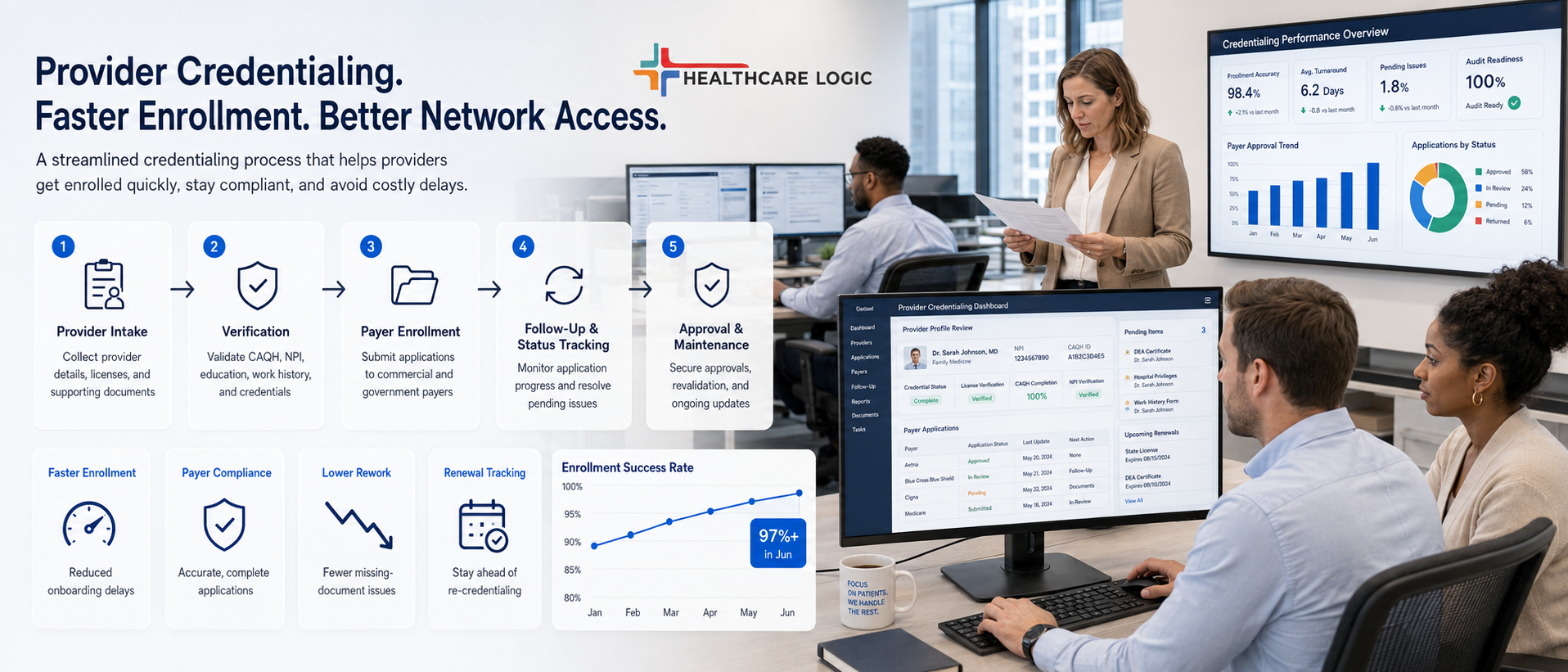
From Documentation to Active Enrollment in the Shortest Timeline Possible

A five-stage credentialing workflow built to compress enrollment timelines, eliminate application errors that restart the clock, and keep every provider's credentials current without burdening your administrative team.

Stage 01
Document Collection
We collect all required provider documents via a structured intake checklist: license, DEA, board certification, malpractice history, CV, NPI, and educational credentials. Missing items are identified immediately so nothing stalls the application later.
Stage 02
CAQH Setup
CAQH ProView profile is created or updated with complete, accurate information and all supporting documents uploaded. Initial attestation is completed so commercial payer applications can proceed without delay.
Stage 03
Applications Submitted
Payer-specific applications are completed and submitted within 5 to 7 business days of receiving complete documentation, for all payers on the enrollment list simultaneously. PECOS and state Medicaid applications go out in the same batch.
Stage 04
Active Follow-Up
Every application is tracked weekly. Payer requests for additional information are responded to within 48 hours. Status updates are documented and shared with the practice so the team always knows which payers are approved and which are still pending.
Stage 05
Approval and Maintenance
Once approved, effective dates and provider IDs are documented and confirmed with billing. The provider enters our ongoing maintenance program for re-credentialing tracking, CAQH re-attestation, and credential expiration monitoring going forward.
Complete Lifecycle Management

Credentialing That Never Falls Off the Calendar.

Most credentialing problems are not caused by payer complexity. They are caused by no one owning the process. Healthcare Logic is a dedicated credentialing team for every client, with a structured tracking system, proactive follow-up, and reporting that gives your practice full visibility into every provider's enrollment status at all times.

All Provider Types, All Specialties, All 50 States

We credential physicians, NPs, PAs, CRNAs, psychologists, LCSWs, LPCs, MFTs, dentists, physical therapists, chiropractors, and all other licensed clinical providers. Medicaid enrollment is covered in all 50 states, and Medicare enrollment is managed for all provider types through the PECOS system.

Re-Credentialing Initiated 120 Days Before Every Deadline

We track every re-credentialing deadline for every enrolled provider and initiate the renewal process 120 days in advance. No deadline is missed. No provider lapses. No billing disruption from an overlooked renewal that nobody on your team had time to track.

CAQH Re-Attestation Managed Every 120 Days

We manage the mandatory CAQH re-attestation cycle for every provider on your roster. Profiles are reviewed, updated, and re-attested on schedule so commercial payer applications are never delayed by an expired profile and so payers always have current information for re-credentialing processes.

Monthly Enrollment Status Reports for Practice Leadership

Every month, practice administrators and billing managers receive a full credentialing status report showing active enrollments, pending applications with expected completion dates, upcoming renewal deadlines, and any credential documents approaching expiration so nothing is ever a surprise.

Credentialing Performance Dashboard
Applications Submitted on Time100%
Avg Enrollment Timeline68 Days
Re-Credentialing Lapse Rate0%
CAQH Re-Attestation On Time100%
On-Time Submission Rate100%
CAQH Re-Attestation Compliance100%
Re-Cred Deadline Miss Rate0%
0%
Credentialing lapse
rate across all clients

Credentialing Services Configured for Your Provider Roster

Credentialing requirements vary significantly by provider type, specialty, payer mix, and care setting. Healthcare Logic configures every credentialing workflow to match your specific roster and organizational structure.

FQHCs & Community Health Centers

Federal Designation and Payer Enrollment

  • FQHC Look-Alike and 330-funded site Medicare and Medicaid enrollment
  • Individual provider enrollment linked to the FQHC organizational NPI
  • Mid-level provider credentialing including NPs, PAs, and CNMs under FQHC billing
  • Sliding fee discount program compliance documentation for payer records
  • State Medicaid managed care organization enrollment for all FQHC providers
Multi-Specialty Practices

High-Volume Provider Roster Management

  • Simultaneous credentialing for multiple new providers joining the group
  • New location enrollment for all existing providers at expanded sites
  • Specialty-specific payer credentialing requirements by service line
  • Group NPI management and individual-to-group benefit reassignment
  • Annual credentialing calendar delivered to practice leadership
Behavioral Health Practices

Mental Health Payer Panel Enrollment

  • Psychologist, LCSW, LPC, MFT, and LMHC payer panel enrollment
  • Mental health parity-compliant payer network participation verification
  • EAP panel enrollment for employer assistance program billing
  • Telehealth credentialing and multi-state licensure enrollment management
  • Substance use disorder specialty payer enrollment requirements
Rural Health Clinics and CAHs

Rural Designation and Government Enrollment

  • RHC and CAH Medicare and Medicaid facility enrollment management
  • Individual provider PECOS enrollment linked to RHC or CAH organizational billing
  • Locum tenens provider credentialing and temporary enrollment management
  • State Medicaid enrollment for frontier and rural health programs
  • Ongoing tracking of cost report and enrollment compliance requirements
Cardiology and High-Value Specialties

Specialty Payer Network Enrollment

  • Cardiology, orthopedics, and neurology specialty panel enrollment
  • Interventional and procedural specialty payer credentialing requirements
  • Hospital medical staff privileging support and re-appointment coordination
  • ASC and facility-based provider enrollment alongside professional billing enrollment
  • Commercial payer specialty network open and closed panel management
Hospitals and Health Systems

System-Wide Provider Roster Credentialing

  • High-volume provider onboarding credentialing across all departments
  • Medical staff office coordination for hospital privileging alongside payer enrollment
  • Travel and contract provider credentialing and temporary enrollment programs
  • System-level group NPI enrollment across multiple affiliated entities
  • Credentialing compliance reporting for accreditation and governance requirements

Frequently Asked Questions About Provider Credentialing

Credentialing timelines vary by payer and provider type. Medicare enrollment through PECOS typically takes 30 to 60 days for clean applications. Medicaid state plan enrollment ranges from 60 to 120 days depending on the state. Commercial payer enrollment timelines range from 60 to 180 days depending on the payer and plan type. Healthcare Logic submits applications within 5 to 7 business days of receiving complete provider documentation and tracks every application through to approval.
Healthcare Logic credentials all provider types across all specialties: physicians (MD and DO), nurse practitioners, physician assistants, CRNAs, clinical psychologists, licensed clinical social workers, licensed professional counselors, marriage and family therapists, dentists, physical and occupational therapists, speech-language pathologists, chiropractors, and other licensed clinical providers. We also manage group practice enrollment, facility enrollment for FQHCs and CAHs, and organizational NPIs.
When a provider renders services to a patient whose insurance is with a payer for which the provider is not yet credentialed or enrolled, the practice cannot bill that payer as a participating provider. Claims submitted under an uncredentialed provider are denied or paid at out-of-network rates, which are significantly lower than contracted in-network rates. For new providers joining a practice, credentialing delays of 60 to 180 days can represent substantial lost revenue if the practice sees patients before enrollment is complete.
CAQH ProView is a centralized credentialing data repository used by most commercial payers as the primary source for provider credentialing information. Maintaining a current, complete, and attested CAQH profile is a prerequisite for credentialing with most major commercial payers including Aetna, Anthem, BCBS, Cigna, and United Healthcare. CAQH profiles must be re-attested every 120 days to remain active. Healthcare Logic manages CAQH profile creation, completion, and ongoing re-attestation for all enrolled providers.
Yes. Re-credentialing is typically required every two to three years by payers and hospital medical staffs. Healthcare Logic tracks re-credentialing deadlines for every enrolled provider and initiates the re-credentialing process 120 days before each deadline, ensuring providers are never lapsed. Ongoing credential maintenance includes CAQH re-attestation every 120 days, DEA and state license renewal tracking, malpractice coverage verification, and board certification renewal monitoring.
Yes. Healthcare Logic manages Medicare enrollment through the PECOS system for individual physicians, non-physician practitioners, group practices, and facility-based providers including FQHCs, RHCs, and CAHs. We also manage Medicaid enrollment in all 50 states, including state Medicaid fee-for-service programs and Medicaid managed care organizations. For FQHCs and RHCs, we manage the additional CMS certification requirements that apply to federally-qualified and rural health clinic designations.

Get Your Providers Credentialed and Billing Faster

Get a free credentialing gap assessment from Healthcare Logic. We will identify your active enrollment gaps, upcoming re-credentialing deadlines, expired CAQH profiles, and the estimated revenue impact of your current credentialing status.

Get Your Free Credentialing Assessment
Healthcare Logic RCM team
From the Blog

Related Insights