














“
Our AR over 90 days was sitting around 31 percent when we came on. Two quarters later it's under 12. The weekly denial report is honestly the first thing I open every Monday now.
End-to-end healthcare revenue cycle management services for FQHCs, Rural Health Clinics, Critical Access Hospitals and multi-specialty provider organizations, supported by experienced teams, automation and real-time analytics.
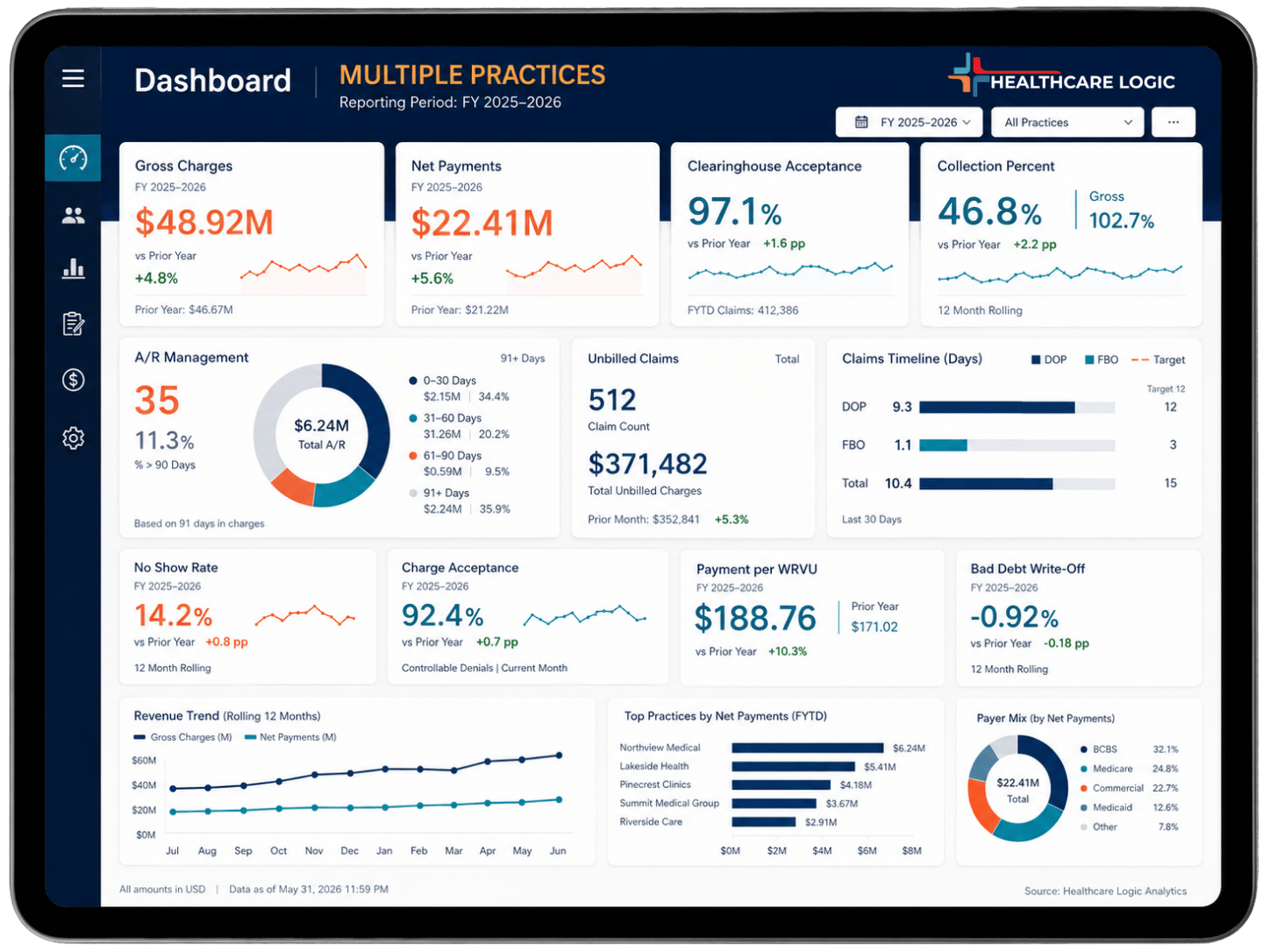
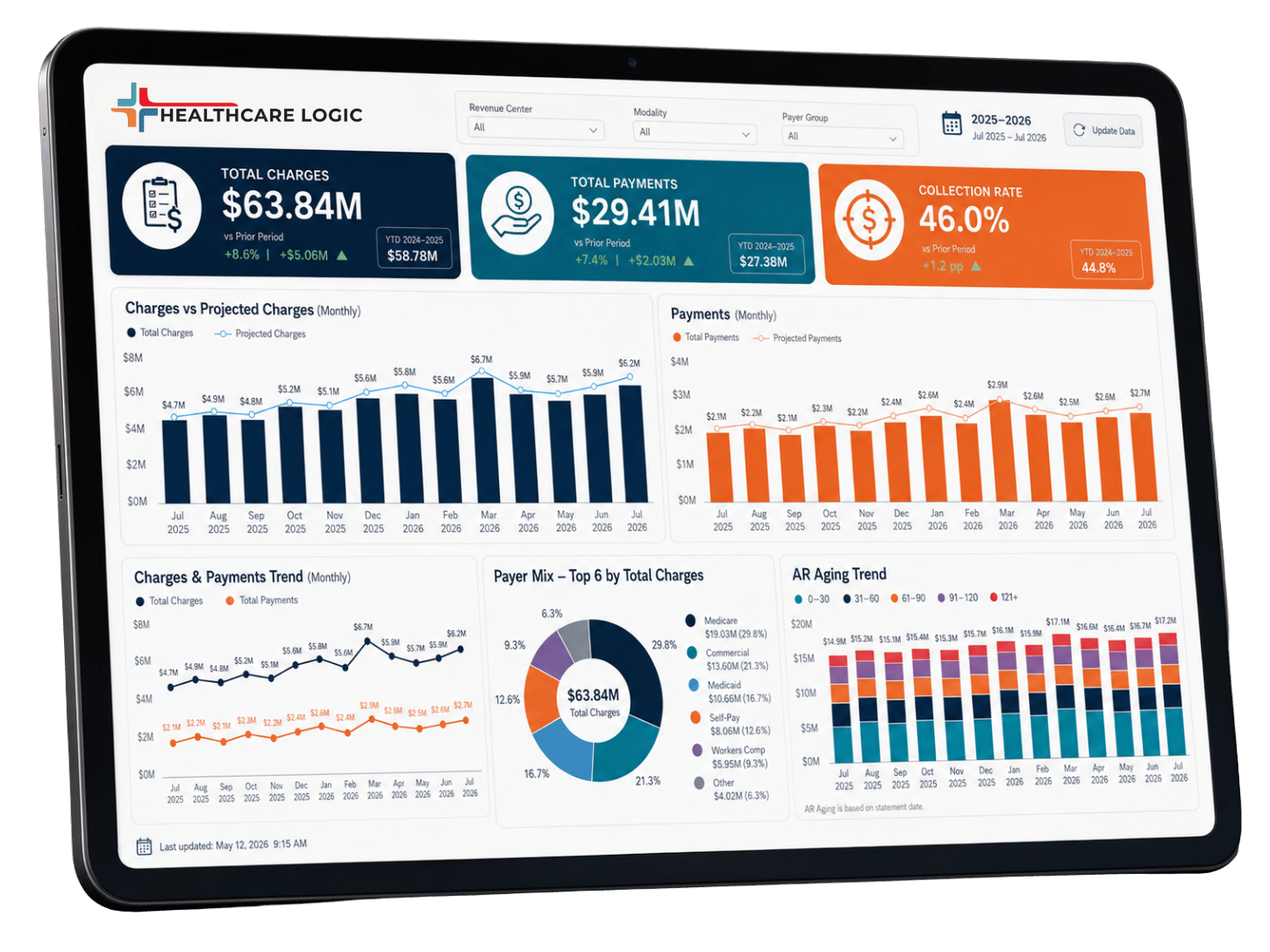


Healthcare Logic is a U.S.-based revenue cycle management company headquartered in Chatsworth, California. We deliver RCM services and medical billing services to safety-net providers, rural organizations, hospitals and specialty practices across Medicare, Medicaid and commercial payer workflows.
One coordinated workflow from patient access and coding through payment posting, denials and final resolution.
Automation and analytics improve visibility and consistency while experienced teams remain accountable for execution.
Security-conscious workflows designed to protect patient information throughout the revenue cycle.
From the first patient interaction through final payment, our teams coordinate the workflows that affect claim quality, payment speed and financial visibility.
Patient scheduling support designed to reduce no-shows, improve access and protect provider capacity.
Explore SchedulingAccurate authorization workflows that help reduce avoidable treatment and claim delays.
Explore Prior AuthorizationCoverage and benefit checks before service to help prevent eligibility-related denials.
Explore EligibilityCertified medical coding services covering ICD-10, CPT and HCPCS, focused on accuracy, compliance and clean claims.
Explore Medical CodingStructured payer follow-up and root-cause analysis to resolve denials and reduce aging receivables.
Explore A/R & DenialsEnrollment, revalidation and payer follow-up that help providers begin billing with fewer avoidable delays.
Explore CredentialingKeeping billing in-house works until claim volume, payer complexity or staff turnover catches up with it. Here is what changes when providers outsource medical billing to a dedicated revenue cycle management company.
Dedicated RCM teams and automation typically cost less than building an equivalent in-house billing department, without the hiring, training and turnover overhead.
Certified coders and structured claim audits catch errors before submission, reducing denials tied to coding, documentation and payer-specific rules.
Consistent charge entry, clean claims and active denial follow-up shorten the time between service delivery and payment.
Our workflows account for the payer rules, coding requirements and reimbursement models that differ across safety-net care, rural health, hospitals and medical specialties.
PPS billing, Medicaid and UDS-aligned workflows
AIR billing and rural payer workflows
Cost-based reimbursement and CAH billing
High-volume walk-in clinic revenue management
ED billing and E/M coding support
Skilled nursing and long-term care billing
Outpatient billing and coding support
Complex cardiac billing and coding
Mental health and substance use billing
Renal and dialysis revenue management
Technology should make the revenue cycle easier to understand and manage, not add another layer of complexity.
Hey Ariana gives teams faster access to revenue cycle information, performance questions and workflow insights. It supports decision-making while experienced revenue cycle professionals remain responsible for follow-up and resolution.
Explore Hey ArianaRPA supports repetitive workflows such as eligibility checks, claim-status activity and data entry, helping reduce manual effort and improve process consistency.
Explore RPAFinance and operational leaders gain clearer visibility into A/R aging, denial trends, payer performance, collections and other revenue cycle KPIs.
Explore Logic AnalyticsHealthcare Logic supports major EHR, practice management and clearinghouse environments, with implementation designed to minimize operational disruption.
Our AR over 90 days was sitting around 31 percent when we came on. Two quarters later it's under 12. The weekly denial report is honestly the first thing I open every Monday now.
I braced for a messy transition when we switched mid-year and it just… wasn't. They mapped our existing workflow first, kept our clearinghouse, and we never missed a collections cycle.
What sold me was that they actually understood RHC wrap-around payments. Our previous vendor was under-billing the encounter rate for months and nobody caught it. Onboarding wasn't flawless, but the recovery work paid for itself fast.
The coding accuracy is the real difference. Our E/M downcoding basically stopped and the clean-claim rate is north of 96 percent now. I can finally forecast cash with a straight face.
Credentialing used to eat my entire week. They took it over completely and new clinicians are getting paneled in about half the time. That alone gave me my evenings back.
They feel like an extension of our team, not an outsourced call center. When a payer changes a policy we usually hear it from them before the payer ever tells us.
We were leaking money on charge entry and had no idea. Their first audit found roughly forty thousand in missed charges in a single quarter. Tough number to look at — but at least now we actually capture it.
Reporting is the part I didn't expect to care about. I used to wait two weeks for numbers from our old biller. Now it's just there in the dashboard. Wish I'd switched sooner.
Denials used to sit in a pile until someone had time. Now there's an actual process and a person accountable for each payer, and our overturn rate has climbed steadily for three quarters straight.
Cost-based reporting for a CAH is its own universe. They knew the cost-report implications cold and kept our Medicare reimbursement clean straight through the audit. No surprises, which is exactly what I want from billing.
Request a complimentary revenue cycle assessment to identify preventable denials, aging A/R, workflow gaps and opportunities for stronger financial visibility.
Get My Free Assessment
Straight answers to the questions we hear most from FQHCs, rural clinics, hospitals and specialty practices evaluating revenue cycle management services.
Most prior auth denials trace back to three things: missing clinical documentation, submitting to the wrong payer portal, and no follow-up until the claim is already denied. The fix is checking auth requirements before the visit is booked, submitting with the clinical criteria the payer actually scores against, and tracking every pending auth to approval instead of waiting. Our prior authorization services handle payer portals, peer-to-peer scheduling, and status follow-up so procedures are not delayed and revenue is not written off.
Roughly a quarter of denials start at the front desk: expired coverage, wrong plan on file, missing secondary insurance, or a patient who switched payers since the last visit. These become eligibility denials, coordination of benefits denials, or surprise patient balances nobody can collect. Running real-time eligibility and benefits verification before every encounter catches coverage changes, copay and deductible amounts, and plan limits while the patient can still be told what they owe.
Payer enrollment typically runs 90 to 180 days, and a provider who is not credentialed cannot bill, so every week of delay is unbilled revenue. New practices are hit hardest because they need CAQH setup, NPI and taxonomy, Medicare and Medicaid enrollment, and commercial contracts running in parallel. We manage provider credentialing and payer enrollment end to end, including credentialing for new clinicians, revalidations, and roster maintenance so start dates and billing dates line up.
Safety-net billing runs on encounter-based reimbursement rather than fee-for-service. FQHCs bill a PPS rate, RHCs bill an all-inclusive rate, and both have wrap-around payments, sliding fee scale patients, 340B considerations, and grant reporting that standard billing teams routinely mishandle. We build RCM specifically for FQHCs, rural health clinics, and community health centers, including qualifying visit rules, same-day visit billing, and UDS-aligned reporting.
Working denials one claim at a time never fixes the underlying leak. We segment A/R by payer, denial reason code, and age, then fix the root cause upstream while appealing what is recoverable. That means CARC and RARC analysis, timely filing triage, and appeals with the documentation the payer needs the first time. Practices moving to our A/R and denial management services typically see days in A/R drop and aged buckets over 90 days shrink because the same denial stops recurring.
Yes, in both directions. Undercoding gives away work you already performed, and overcoding invites audits and takebacks. Missed modifiers, wrong E&M level, unbundled CPT codes, and specificity gaps in ICD-10 quietly reduce reimbursement on every claim. Our certified coders handle medical coding and coding audits across specialties, with regular chart audits so the coding matches the documentation and the documentation supports the code.
Yes. High-volume, unscheduled care has its own problems: incomplete registration, self-pay-heavy patient mix, facility versus professional splits, and observation versus inpatient status. Critical access hospitals bill under cost-based reimbursement with method I and method II election rules, and emergency department billing is heavily scrutinized on E&M leveling and medical necessity. We staff these separately from routine clinic billing because the payer behavior is different.
Patient responsibility keeps rising with high-deductible plans, and most of the loss happens because balances are communicated late and vaguely. Collecting improves when the estimate is given before or at the visit, the statement is readable, and payment plans exist for larger balances. Our self-pay collection and patient invoicing covers point-of-service estimates, clear statements, and payment plans so patients are not surprised and balances are resolved earlier.
In-house makes sense when volume is steady and you have depth on the team. It breaks down when a biller leaves, a payer changes rules, or growth outpaces staffing, because A/R quietly ages while nobody has capacity. Outsourcing converts a fixed staffing cost into a variable one and adds specialty coding, credentialing, and denial expertise you would otherwise hire separately. Our RCM solutions can run the full revenue cycle or just the segment that is leaking, such as A/R cleanup, coding, or credentialing.
We staff by specialty because payer rules are not interchangeable. That includes behavioral health with time-based and telehealth coding, cardiology, radiology with professional and technical splits, orthopedics with global surgical periods, dermatology, neurology, pain management, nephrology and dialysis, retina with buy-and-bill drugs, dental, chiropractic, ambulatory surgery, and skilled nursing.
Share a few details and our team will review your current workflow for denials, aging A/R and coding gaps at no cost.
Results are specific to that engagement and are not a guarantee of future performance. Read the case study
Participation in healthcare associations helps our teams stay engaged with policy changes, reimbursement priorities and operational challenges affecting community health, rural care and provider organizations nationwide.